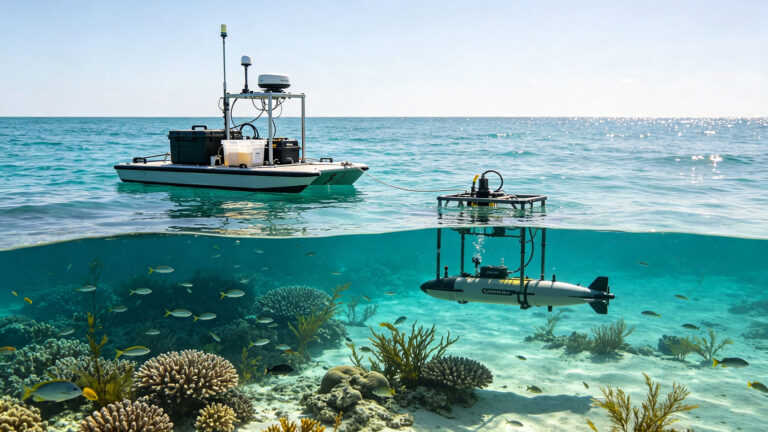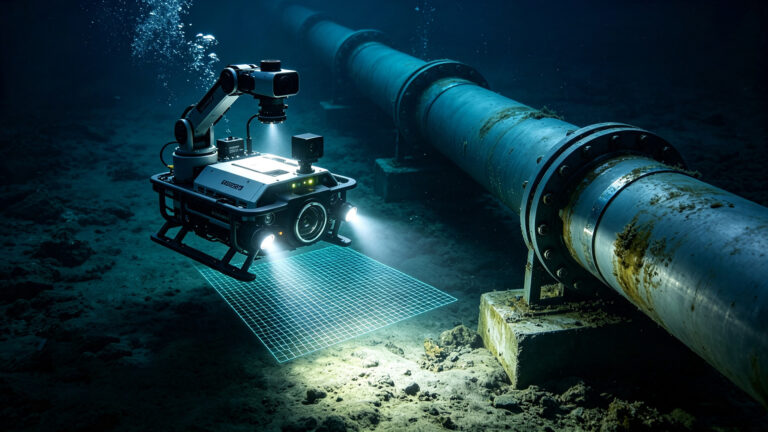

This guide walks you through every critical factor you should evaluate before making a purchase. By the end, you’ll know exactly what to look for — and what to avoid — so you can confidently select a USV that matches your mission, your budget, and your operational reality.
1. Define Your Mission First
Everything starts with your primary task. A USV built for shallow-water bathymetry is very different from one designed for offshore patrol. Start by answering:
- Hydrographic surveying / mapping – You’ll need a stable platform with mounting space for multibeam or singlebeam echosounders.
- Environmental monitoring – Look for an easily deployable USV that can carry water quality sondes, automatic samplers, and ADCPs.
- Security & patrol – Speed, endurance, and a high-performance electro-optical/infrared (EO/IR) payload are key.
- Scientific research – Modular deck space, open software interfaces, and the ability to tow small instruments are must-haves.
Be specific. A USV that does “a bit of everything” often masters none.
2. Hull Type: Monohull, Catamaran, or Inflatable?
The hull is the foundation of your USV’s performance.
- Monohull – Simple, self-righting in some designs, and generally more efficient at higher speeds. Great for surveys where you need to cover a lot of ground, but deck space can be limited.
- Catamaran (twin-hull) – Exceptional lateral stability, large payload deck between the hulls, and the ability to install transducers in a moon pool or between the hulls. Ideal for multibeam mapping and water sampling.
- Inflatable / RIB-style – Lightweight, portable, and robust against collisions. Excellent for rapid deployment from a small boat or vehicle, often used in security and rescue.
What to ask: Will you be deploying from a slipway, a mother vessel, or by hand? Choose a hull that matches your launch and recovery method.
3. Power & Endurance: The Real Numbers Matter
Manufacturers often quote endurance at a very slow, unloaded cruise speed. To avoid disappointment, dig deeper.
- Pure electric – Quiet, zero emissions, low maintenance. Best for small lakes, reservoirs, and short-duration coastal work. Actual useful endurance with a full payload is often 3–6 hours.
- Hybrid (diesel/electric or gas/electric) – Much longer range, with the ability to run on clean electric power in sensitive zones. The added complexity means more maintenance.
- Solar-assisted – Extends the day, but rarely replaces onboard batteries entirely. Excellent for long-duration loitering missions.
- Fuel-powered – High speed, long range, refuel quickly. Ideal for offshore patrol and security.
When comparing, ask the vendor: What is the usable endurance with my specific payload at a normal survey speed of 4–5 knots? That’s the number you’ll actually experience.
4. Payload Integration: It’s More Than a Bolt-On
Your USV is just a platform; the sensors do the work. Pay attention to:
- Mounting & stability – Where does the multibeam transducer sit? Is there a moon pool, over-the-side pole mount, or hull recess? The position affects data quality.
- Power supply – Can the USV provide clean, regulated 12V, 24V, and 48V DC outputs simultaneously for multiple sensors?
- Weight & balance – Adding a heavy winch or ADCP changes the trim. Look for adjustable ballast or modular payload bays.
- Data integration – Ideally, all sensor data is time-stamped and logged into a single topside software, or at least easily accessible for post-processing.
A well-integrated payload is the difference between clean survey data and a frustrating day on the water.
5. Autonomy & Obstacle Avoidance
Modern USVs offer several levels of autonomy. Which do you actually need?
- Waypoint following – The basic must-have. The USV follows a predefined route with GPS.
- Dynamic positioning / station keeping – Holds position and heading against wind and current. Critical for water sampling or inspecting a fixed structure.
- Collision avoidance (COLREGs-aware) – Sensors like marine radar, AIS, LiDAR, and cameras allow the USV to detect and avoid other vessels according to navigation rules. This is essential for autonomous operation in busy waterways.
- Perception sensors – A good setup might combine a solid-state marine radar for long-range detection with stereo cameras or LiDAR for close-range obstacles and visual identification.
If you’ll operate near other boats, don’t skimp on collision avoidance. It protects your investment and is a regulatory expectation in many areas.
6. Communication Links: Staying in Control
Real-time control and data streaming depend on robust communications.
- Point-to-point radio (900 MHz / 2.4 GHz) – Reliable for line-of-sight operation up to a few kilometers. Simple and license-free in many regions, but limited in range.
- 4G/5G cellular – Excellent for coastal and inland waters with good coverage. Allows real-time HD video and data transfer over long distances. Consider a multi-SIM router that switches between carriers.
- Satellite (Iridium, Starlink Maritime) – Enables truly over-the-horizon operations. Costs are dropping, and it’s becoming the standard for long-range autonomous missions.
- Mesh / self-healing networks – Useful when operating multiple USVs or an unmanned team (USV + UAV).
Think about your operational range. If your survey area often exceeds 2-3 km from shore, a 4G/5G or satcom solution should be in your plan from the start.
7. Control Software: Open vs. Closed Ecosystem
The software defines your daily experience.
- Open-source (e.g., Mission Planner, QGroundControl, ROS-based) – High flexibility, large community, and no licensing fees. Perfect if you have in-house developers or want to integrate custom payloads. However, the learning curve can be steep.
- Proprietary (vendor-specific) – Designed for a seamless experience. Features like survey planning, data visualization, and vehicle health monitoring are integrated and polished. You pay a license or it’s built into the purchase price, but you get reliable support.
- Web-based / cloud options – Some manufacturers now offer browser-based mission control, so you can monitor and replan from any device. This is extremely useful for team collaboration.
Ask for a live demo of the software. If it feels clunky during a 30-minute trial, it won’t get better after 8 hours on the water.
8. Regulations, Insurance & After-Sales Support
The best USV is useless if you can’t legally operate it or get it repaired quickly.
- Local maritime regulations – Many countries now require registration of USVs above a certain size, plus a license for radio frequencies. Check the rules in your operating area. Your vendor should provide guidance and compliance documentation.
- Insurance – Hull insurance and third-party liability are increasingly available. Some underwriters offer policies specifically for unmanned marine systems. Factor this into your annual budget.
- Training & support – Will the supplier train your team? Is there a local service partner or do you need to ship the USV overseas for repairs? What’s the typical response time for technical questions?
- Spare parts – Common wear items (propellers, O-rings, batteries) should be easily orderable. Ask about a recommended spares package.
A slightly more expensive USV with a local service center can have a far lower total cost of ownership than a cheaper import with zero support.
Find Your Perfect USV in Our Store
Choosing a USV is about matching the right tool to your specific job. Resist the temptation to over-spec “just in case” or under-buy to save money upfront. The sweet spot is a system that does your core mission reliably, with a little room to grow.
Ready to find your ideal unmanned surface vehicle?
[Browse our USV collection] or [Contact our team] for a personalized consultation. We’ll help you navigate the options and configure a system that fits your mission — and your budget — perfectly.