
In this article, we’ll show you exactly how modern USVs are being deployed for water monitoring, what sensors they can carry, how they save time and money, and how to build your own USV-based monitoring system.
1. A Complete Family of Water Quality Sensors Onboard
Today’s USVs aren’t just boats — they’re floating laboratories. With modular payload bays and through-hull sensor wells, they can simultaneously measure a wide range of parameters in real time:
- Multiparameter water quality sondes – Measure temperature, conductivity, pH, dissolved oxygen, turbidity, chlorophyll-a, blue-green algae, and more. Leading brands like YSI EXO, In-Situ Aqua TROLL, and Eureka Manta can be integrated directly.
- ADCP (Acoustic Doppler Current Profiler) – Profiles water currents and discharge at multiple depths simultaneously. Ideal for stream gauging and estuary studies.
- Nutrient analyzers – Wet-chemistry analyzers for nitrate, phosphate, and ammonia are increasingly compact and can run autonomously onboard for hours.
- Hydrocarbon fluorometers – Detect oil in water in real time, critical for industrial outfall monitoring.
- Hyperspectral radiometers – For satellite validation and water leaving reflectance measurements.
All these instruments feed time-stamped, geo-referenced data into a single onboard logger, which can transmit it live to your laptop or the cloud.
2. Automatic Sampling and Adaptive Survey Patterns
Beyond real-time sensors, many USVs can carry automatic water samplers — essentially a rack of bottles that are triggered at pre-set locations, depths, or when a specific sensor threshold is exceeded (e.g., turbidity spike).
The real power of a USV, however, is its ability to follow intelligent survey patterns:
- Pre-planned grid surveys – Perfect for lake baseline studies. The USV travels a lawnmower pattern, collecting data evenly across the waterbody.
- Along-river transects – Follow the thalweg or zigzag across the channel to capture mixing zones.
- Adaptive sampling – If an onboard fluorometer detects a chlorophyll peak, the USV can automatically tighten its survey grid around the hotspot, trigger a sample bottle, and alert the operator.
- Vertical profiling – With an integrated winch, the USV can stop at each waypoint, lower a sensor package through the water column, and record a full profile before moving on.
This means you no longer need to guess where to sample. The USV adapts to the data it’s collecting in real time.
3. Real-World Scenarios: Lakes, Rivers, and Coastal Waters
Let’s look at how our customers are using USVs today:
Lake & Reservoir Management
A drinking water utility deploys a solar-assisted USV weekly to monitor a 5 km² reservoir. The USV follows a pre-programmed grid, measuring dissolved oxygen, temperature, and chlorophyll-a. When an anoxic zone is detected near the bottom intake, managers adjust withdrawal depth immediately, preventing a taste-and-odor event. Before the USV, they relied on four fixed buoys that missed the developing dead zone entirely.
River & Estuary Monitoring
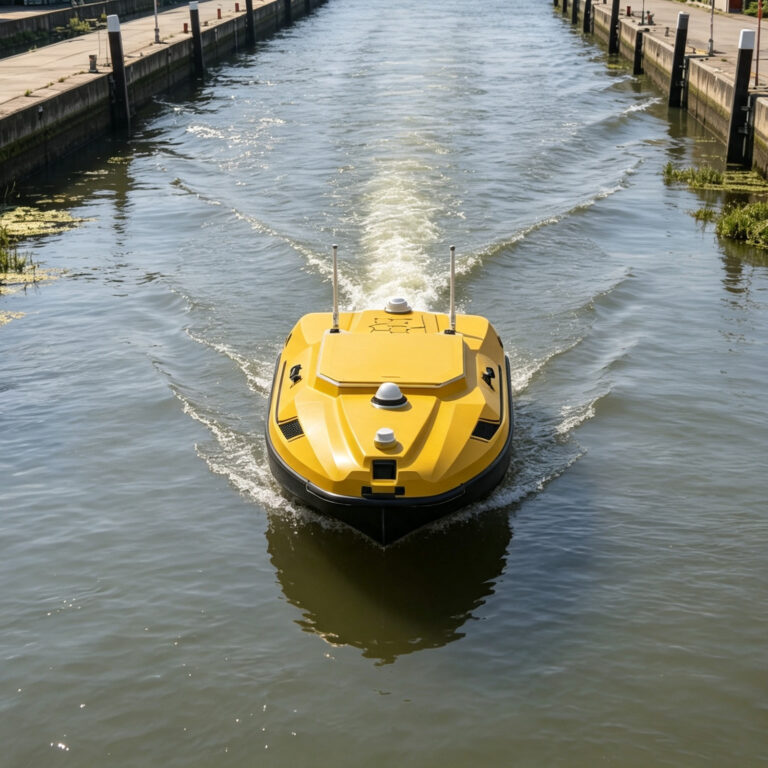
An environmental agency uses a portable catamaran USV to perform monthly discharge measurements at 15 river cross-sections. The USV carries an ADCP and automatically zigzags across the channel. A task that once required a crew of three, a heavy boat, and a full day now takes one technician two hours per site — with higher data quality because the USV holds a perfect, consistent line.
Industrial Outfall & Coastal Compliance
A coastal industrial plant deploys a USV with a hydrocarbon fluorometer and turbidity sensor around its outfall diffuser. The USV patrols a 500-meter perimeter multiple times per day, streaming data to the environmental compliance team. Any anomaly triggers an automatic sample collection and an alert. This proactive monitoring has helped them avoid permit violations and respond to incidents before regulators even ask questions.
4. Real-Time Data Link: From Sensor to Cloud in Seconds
The old model: collect samples → send to lab → wait days → get a spreadsheet. With a USV, the data pipeline is live:
- Telemetry – 4G/5G cellular modems are the most common for coastal and inland work, providing high-bandwidth video and data. For remote areas, license-free 900 MHz radios can push sensor data tens of kilometers.
- Onboard edge computing – The USV can do initial quality control (QC) flagging — marking suspicious spikes, detecting sensor drift — before data leaves the boat.
- Cloud visualization – Most USV control software now includes a web dashboard where you can see live tracks, parameter heatmaps, and sensor status. Many integrate directly with third-party platforms like ESRI ArcGIS, AQUARIUS, or custom APIs.
- Instant alerts – Set thresholds for any parameter. If dissolved oxygen drops below 4 mg/L or turbidity spikes, the system emails or texts you immediately.
For the first time, you can have a complete, synoptic picture of water conditions the moment the USV returns to shore — or even while it’s still on mission.
5. Safety: Removing People from Harm’s Way
Water monitoring often takes place in dangerous conditions:
- Swift currents during flood gauging
- Contaminated water at industrial sites or wastewater outfalls
- Unstable banks, slippery rocks, and steep reservoirs
- Operating small boats in bad weather or at night
A USV eliminates these risks. The operator remains safely on shore or in a vehicle, controlling the mission via a rugged tablet. The boat handles the dangerous work. For agencies struggling with occupational health and safety requirements, a USV is a straightforward way to dramatically reduce field team exposure.
Emergency response is where this shines. In the event of a chemical spill or fish kill, a USV can be deployed immediately to map the extent and source of contamination — no need to wait for a boat, a crew, or safety gear. Data starts flowing in minutes.
6. The Cost Argument: USV vs. Manned Boat vs. Spot Sampling
Let’s look at the numbers. A typical one-day lake monitoring program using traditional methods might involve:
- Rental of a boat or use of a department vessel (~$500-1500/day including fuel)
- 2-3 field staff (salary, travel, overhead)
- Sampling bottles and lab analysis costs (~$50-100 per sample, 10-20 samples per day)
- Post-processing time
Total cost per monitoring event: $2,000 – $4,000 easily.
A well-chosen USV system (priced between $15,000 and $60,000 depending on sensors) can be amortized quickly. After the initial purchase, the per-survey cost drops to a single operator’s time plus negligible electricity for battery charging. Many of our customers report a return on investment within the first year, even before factoring in the value of higher-resolution data and early pollution detection.
When you consider that one avoided water quality violation or one early-caught algal bloom can save a utility hundreds of thousands in treatment costs and fines, the USV essentially pays for itself.
7. How to Build Your USV Monitoring System: A Quick Checklist
Ready to put together your own system? Here’s a straightforward selection checklist:
- Define your waterbody and parameters – Freshwater lake? Estuary? Coastal? List the exact parameters you must measure (DO, pH, turbidity, chlorophyll, ammonia, etc.).
- Choose the USV platform – Small portable catamaran for lakes and rivers; larger monohull or hybrid for coastal endurance. Consider solar assist if you need all-day missions.
- Sensor integration – Work with a supplier who has pre-engineered mounting kits for your preferred sonde and ADCP. Confirm power and data compatibility.
- Sampler requirement – Do you need grab samples for lab verification? Choose a model with an integrated automatic water sampler (4, 8, or 24 bottles).
- Telemetry – 4G/5G for coverage areas; radio for remote spots. Ensure the USV has a fail-safe “return to home” if communication is lost.
- Software & cloud – Make sure the ground control software can plan grid surveys and export to your GIS or database format. Ask about API access if you need custom integration.
- Training & support – Confirm that training is included, and ask about local maintenance support. Sensor calibration and routine checks are critical for data credibility.
Step Into Smarter Water Monitoring
Water quality monitoring is entering a new era — one where you can see the full picture, in real time, without putting anyone in danger. A modern USV turns a labor-intensive, expensive chore into a routine, one-person task that produces richer data and actionable insights.
Ready to see what a monitoring USV can do for your program?
[Browse Water Quality USV Systems] or [Request a Custom Configuration] — our team will help you match the right platform and sensors to your exact monitoring objectives.