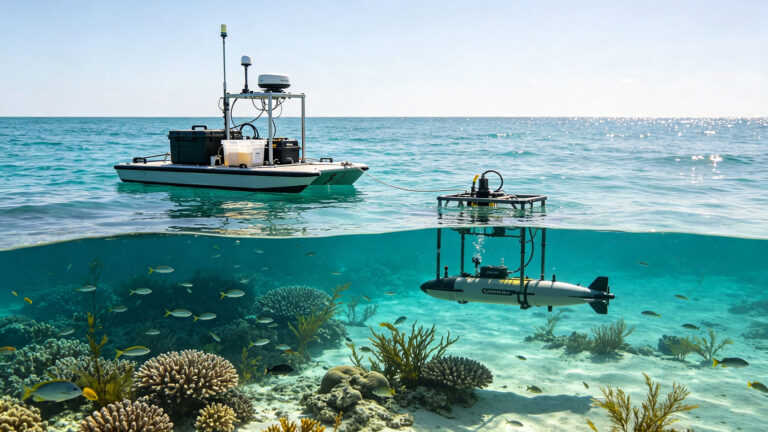

This guide breaks down the differences, strengths, and ideal applications for each, so you can make a confident, informed purchase.
1. What Is a UUV? A Quick Definition
A UUV is any untethered or tethered submersible vehicle that operates without a human onboard. Within this broad category, we distinguish:
- AUV (Autonomous Underwater Vehicle): Operates without a physical cable. It runs pre-programmed missions using onboard batteries and computers, surfacing or returning to a docking station when done.
- ROV (Remotely Operated Vehicle): Connected to a surface vessel or shore station by a tether (umbilical cable). A human pilot controls it in real time, receiving live video and sensor data.
Both are “underwater drones,” but the presence or absence of that tether fundamentally changes everything about how they work.
2. AUV Deep Dive: Cable-Free Autonomy for Wide-Area Surveys
An AUV is like a submarine on autopilot. You program a mission, launch it, and it navigates underwater using inertial navigation, Doppler velocity logs (DVL), and occasionally acoustic positioning. No cable means no drag, no risk of entanglement, and the freedom to cover large distances.
Key strengths:
- Large area coverage – An AUV can survey kilometers of seabed, pipeline, or reservoir floor in a single dive.
- Hydrodynamic efficiency – Without a heavy tether, it can reach higher speeds and use less energy, extending endurance to 8-24+ hours.
- Launch from shore or a small boat – Many lightweight AUVs can be deployed by a single person.
- Under-ice or hazardous environments – No surface connection means it can go where a cabled ROV cannot.
Limitations:
- No real-time human intervention. If something unexpected happens, the AUV must surface or rely on its own onboard logic.
- Data is only available after the mission, unless an acoustic modem is used for low-bandwidth updates.
- Manipulation tasks (like turning a valve or grabbing an object) are extremely difficult.
Ideal for: Hydrographic surveys, oceanographic research, pipeline route inspection, rapid environmental assessment, and defense mine countermeasures.
3. ROV Deep Dive: Tethered Power and Real-Time Control
An ROV is the underwater equivalent of a construction drone with a power cord. The tether supplies high-bandwidth video, unlimited power from the surface, and a direct control link. A skilled pilot can hover in place, use a manipulator arm, and make instant decisions based on what they see.
Key strengths:
- Real-time video and intervention – See a crack on a dam? You can zoom in, inspect, and even use a manipulator to clean or measure it — right now.
- High power availability – Electrically powered through the tether, ROVs can drive powerful thrusters, bright lights, hydraulic tools, and heavy manipulator arms for hours.
- Precision hovering – Station-keeping in strong currents is possible, making detailed structural inspection reliable.
- Deeper operations – Many work-class ROVs operate at 3000m to 6000m, far beyond practical AUV intervention.
Limitations:
- Tether management is the eternal challenge. The cable can snag, tangle, and limit the range of the vehicle to the surface vessel’s movement.
- Requires a surface vessel or platform with a suitable tether management system (TMS), generator, and skilled crew.
- In confined spaces, the tether can create drag and limit maneuverability.
Ideal for: Dam and bridge inspection, ship hull cleaning, aquaculture net repair, search and recovery, offshore oil & gas intervention, and scientific sample collection.
4. Key Specifications Compared
When comparing AUVs and ROVs side by side, these are the numbers and features that matter:
| Specification | AUV (Autonomous) | ROV (Remotely Operated) |
|---|---|---|
| Tether | None | Umbilical (power + fiber optic / copper) |
| Depth Rating | Typically 100m – 6000m for survey-class | 100m – 6000m, observation to work-class |
| Endurance | 8 – 48+ hours on battery | Unlimited (powered from surface) |
| Typical Speed | 2 – 5 knots (efficient cruise) | 0 – 3 knots, high maneuverability |
| Payload | Survey sensors, CTD, side-scan sonar | Cameras, sonar, manipulators, cleaning tools |
| Real-Time Control | None or delayed via acoustic modem | Full pilot control with joysticks |
| Best For | Wide-area mapping, data collection | Inspection, intervention, maintenance |
5. The Rise of Hybrid UUVs
Can’t decide? A new generation of Hybrid UUVs is blurring the line. These vehicles can operate in AUV mode for transit and survey, then switch to a tethered ROV mode (often using a very thin fiber-optic micro-cable) for close inspection and light intervention.
Another form of hybrid is an ROV with autonomous functions — it can auto-hold depth, follow a pipeline autonomously, or keep station while the pilot focuses on the manipulator arm. These platforms offer remarkable flexibility, though at a higher price point than a pure AUV or small ROV.
Tip: If your tasks regularly require both broad area coverage and occasional physical interaction, a hybrid or a dual-vehicle (USV + micro-ROV) setup might be your ideal solution.
6. Application Matchmaker: What Do You Need?
Still unsure? Here’s a quick-task-based selection guide:
- Pipeline & cable inspection – Long linear routes point to an AUV with side-scan sonar for rapid survey. For detailed corrosion inspection, an ROV with cameras and a cathodic protection probe is best. Many operators use an AUV to find the anomalies, then deploy an ROV for a closer look.
- Fish farm & aquaculture – A small, lightweight ROV with a high-res camera is perfect for daily net inspection, mortality removal, and checking moorings. Real-time video is essential to see tears and dead fish immediately.
- Scientific research & oceanography – Depends on the science: water column sampling and plankton surveys often use AUVs with a suite of environmental sensors. Benthic ecology and precise sample collection lean toward an ROV with a manipulator and sample boxes.
- Search & recovery – An ROV with powerful lights, a high-resolution imaging sonar, and a grabber arm is the tool of choice. Real-time piloting lets you react instantly to sonar targets.
- Dam & infrastructure inspection – An inspection-class ROV with a 4K camera, laser scalers, and a cleaning brush is the standard. The tether guarantees real-time assessment of cracks and structural integrity.
7. Popular Sensor & Tool Combinations
Whether you choose AUV or ROV, the payload makes the mission. Here are the most requested add-ons we help customers configure:
- Imaging sonar (e.g., Blueprint Oculus, Teledyne BlueView) – Provides clear imagery in zero-visibility water. Essential for search operations and turbid water inspection.
- Multi-beam echosounder – Creates high-resolution 3D maps of the seabed. Common on survey AUVs.
- Manipulator arms – From simple grabbers to multi-function hydraulic arms with rotating jaws. Allows sample collection, valve turning, and debris removal.
- USBL positioning system – Tracks the vehicle’s location from the surface, so you know exactly where the data was collected.
- Cathodic protection probes – Measures the effectiveness of sacrificial anodes on submerged metal structures.
- Water quality sensors – CTD, dissolved oxygen, turbidity, chlorophyll — common on both AUVs and ROVs for environmental work.
Pro tip: Always think about payload integration before buying. The vehicle must be able to power and communicate with the sensor, and the mounting must keep it stable and away from thruster wash.
8. Cost and Return on Investment
It’s not just about the purchase price. Factor in:
- AUVs generally have a higher upfront cost for a given depth rating due to advanced navigation and autonomy systems. However, they can often be operated by a smaller crew with a simpler vessel, reducing daily running costs.
- ROVs range from a few thousand dollars for a portable inspection unit to millions for a deepwater work-class system. The tether, launch system, and larger crew requirements add operational expense, but the ability to perform real-time intervention can replace an entire dive team.
- ROI calculation tip: Compare the daily cost of your current method (dive team, manned survey vessel, RIB with sensors) against the amortized daily cost of the UUV plus operator. A single avoided dry-docking or a rapid pipeline inspection often pays for the system in one job.
There’s No “Best” UUV — Only the Best Fit for Your Job
The choice between an AUV and an ROV comes down to a simple question: Do you need to see and act now, or do you need to cover a lot of ground efficiently?
For real-time intervention and inspection with a human in the loop, choose an ROV.
For large-scale autonomous surveys and data gathering, choose an AUV.
For a bit of both, explore the hybrid options.
Our team has helped aquaculture operators, marine surveyors, civil engineers, and researchers find the exact underwater drone they need. We carry a curated range of portable inspection ROVs, survey-class AUVs, and modular hybrid platforms ready for immediate deployment.
[Explore Our UUV Collection] or [Talk to an Underwater Robotics Expert] today. Let’s get the right vehicle in the water for you.